Advancing Minimally Invasive Surgical Techniques to Treat Hallux Rigidus
In This Article
- Hallux rigidus is one of the two most prevalent conditions causing pain at the base of the big toe
- Foot and ankle surgeon Christopher Miller, MD, is exploring how to treat hallux rigidus and other conditions using minimally invasive techniques
- A newer procedure that he offers patients is a minimally invasive cheilectomy, first metatarsal shortening osteotomy, and Moberg osteotomy
Pain at the base of the big toe is a common reason patients see primary care physicians and foot and ankle surgeons. The two most prevalent conditions at this site are bunions and hallux rigidus (arthritis of the first metatarsophalangeal, or MTP, joint).

Subscribe to the latest updates from Orthopaedics Advances in Motion
The benefits of minimally invasive approaches for bunions have received widespread coverage in the lay press in recent years. The same cannot be said for hallux rigidus, which has traditionally focused on either removing the bump or fusing the great toe to eliminate motion.
Mass General Brigham foot and ankle surgeon Christopher P. Miller, MD, is an internationally renowned expert on minimally invasive surgery (MIS) for the foot and ankle. Over the past decade, he has been a pioneer in treating an expanding range of conditions with MIS—including hallux rigidus.
Traditional surgical options lacking
Hallux rigidus is the primary form of arthritis affecting the great toe. Over time, the cartilage that lubricates and cushions the MTP joint wears down and bone spurs often form along the top and sides of the joint. The resulting symptoms include stiffness and deformity of the big toe along with pain associated with the bone spurs and joint/tendon contraction.
For decades, the two main surgical options for treating hallux rigidus were open cheilectomy (removal of the bone spurs that block motion) and open fusion of the MTP joint.
The well-known disadvantages of open approaches include soft tissue disruption, scarring, delayed mobilization, and a slower return to activity. Furthermore, cheilectomy generally is not effective for more advanced hallux rigidus, while fusion reliably relieves pain but permanently eliminates range of motion of the big toe. Attempts at joint replacement have largely produced disappointing results to date.
Dr. Miller has been exploring and refining minimally invasive approaches to improve outcomes in patients with hallux rigidus. “The idea is to create a middle ground for people whose arthritis is too severe to be treated with cheilectomy alone but who want to avoid fusion so they can preserve motion while still decreasing pain,” he says.
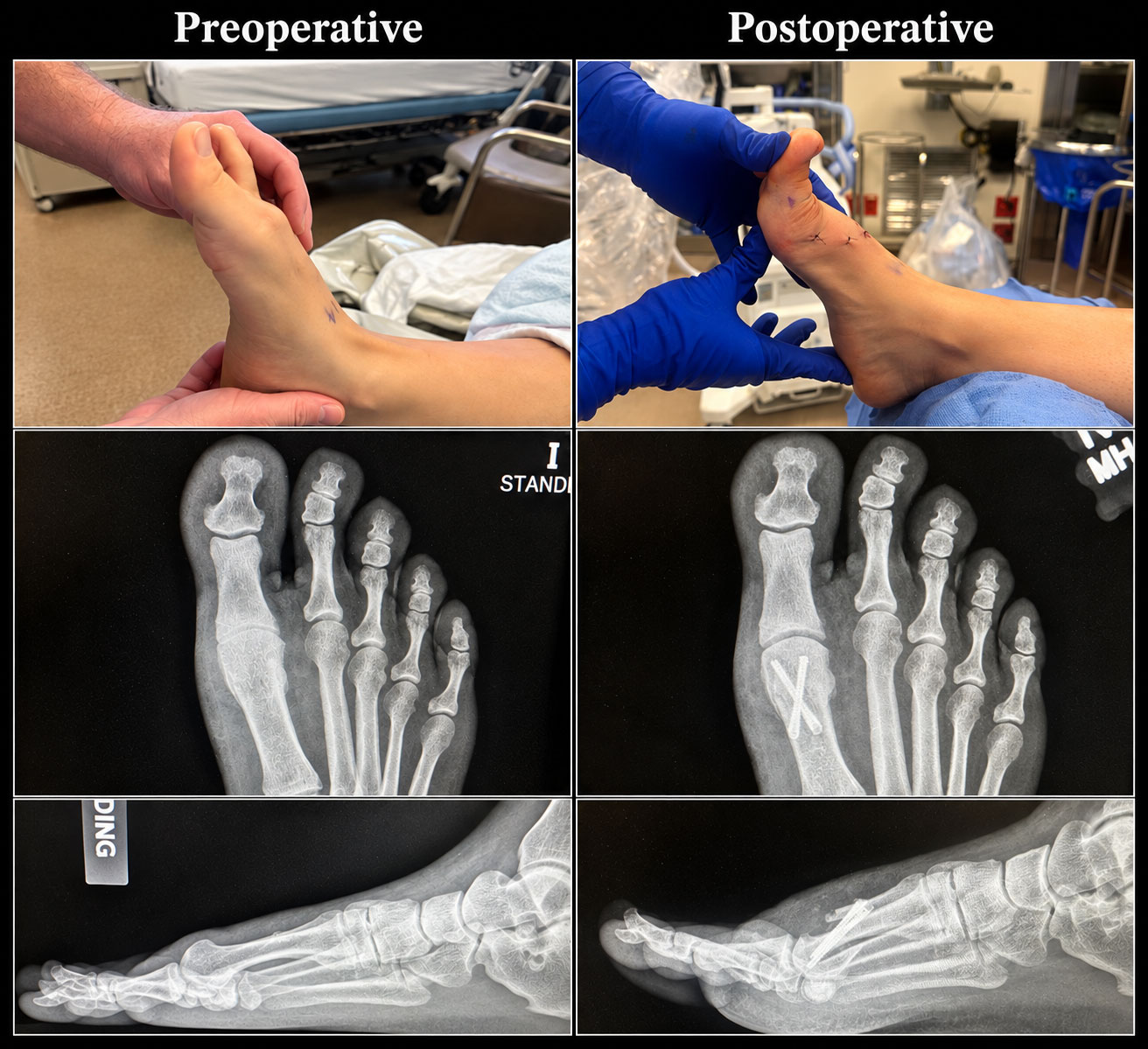
Figure 1
Pre- and post-op clinical photos showing limited toe motion before and improvement after. Also demonstrates improved joint space following realignment and decompression with the shortening and plantar displacement of the implant as well as the three 2mm incisions made to achieve the correction.
Minimally invasive cheilectomy, shortening osteotomy, and Moberg osteotomy
For patients with early-to-moderate hallux rigidus, Dr. Miller has found that minimally invasive cheilectomy can be highly effective. Patients usually can walk in a surgical shoe the day after surgery and transition to regular shoes within two weeks.
For moderate hallux rigidus or cases where cheilectomy alone is insufficient, Dr. Miller can offer other minimally invasive procedures. One is minimally invasive shortening osteotomy (MIVO). He became an early adopter of MIVO after working with and learning from his colleague, Paulo Carvalho, MD, PhD, the Portuguese foot and ankle surgeon who developed and refined the technique.
“Basically, the osteotomy shortens the first metatarsal and repositions the MTP joint in space to decompress the damaged joint and cartilage, allowing for improved biomechanics and motion of the toe,” Dr. Miller says.
Selected patients undergoing MIVO for hallux rigidus may also benefit from minimally invasive Moberg osteotomy. This procedure involves removing a small wedge of bone from the base of the big toe, which enhances dorsiflexion (upward motion of the toe) and further decompresses the MTP joint.
In addition to training with Dr. Carvalho in Portugal, Dr. Miller has traveled to Spain to take courses on MIS foot and ankle surgery. He has also taught these techniques as the chair for the first American Orthopaedic Foot & Ankle Society MIS training course and as an instructor for MIFAS by Grecmip, an international scientific society based in France.
Ultimately, Dr. Miller stresses, mastering minimally invasive techniques enables surgeons to offer the right surgery for each patient with the easiest and safest recovery possible.
“I want to know the patient’s goals—whether that’s getting back to walking or driving or yoga or running—and how the pain in the big toe is limiting them,” he says. “Then it’s a matter of marrying those goals to the patient pathology and figuring out which surgery will achieve the best result for that patient. Now we have more and more avenues to improve outcomes and patient satisfaction.”
Learn about foot and ankle care at Mass General Brigham
Learn about orthopedics and sports medicine at Mass General Brigham