Mass Eye and Ear Sialendoscopy Course: Q&A With Dr. Wais Rahmati
In This Article
- This one-day course provides a comprehensive, hands-on overview of sialendoscopy for the diagnosis and minimally invasive, gland-preserving treatment of salivary gland disorders
- This CME is led by course director Wais Rahmati, MD, MPH, FACS, a board-certified otolaryngologist–head and neck surgeon at Mass Eye and Ear
- In this Q&A, Dr. Rahmati discusses what is new this year and why the course offers a one-of-a-kind learning experience
The Mass Eye and Ear Sialendoscopy Course: Practical Management of Salivary Gland Disorders provides a comprehensive, hands-on overview of sialendoscopy for diagnosis and minimally invasive, gland-preserving treatment. This CME course, held in-person at Mass Eye and Ear on July 17th, is led by course director Wais Rahmati, MD, MPH, FACS, a board-certified otolaryngologist–head and neck surgeon at Mass Eye and Ear.

Subscribe to the latest updates from Otolaryngology Advances in Motion
In this Q&A, Dr. Rahmati shares what’s new in this year’s course and explains what makes it a unique and valuable educational experience.
Q: What makes the Mass Eye and Ear Sialendoscopy Course unique?
Dr. Rahmati: Salivary gland disorders involving the parotid and submandibular glands can have serious medical consequences and significantly affect quality of life. The introduction of sialendoscopy has transformed how we approach these conditions by allowing direct visualization of the ductal system and, in many cases, minimally invasive, gland-preserving treatment.
What stands out about this course is that it is currently the only U.S.-based sialendoscopy course being offered this year. Opportunities for structured, hands-on learning in this area are limited, and this course brings together expert faculty who are leaders across clinical care, research, and education in salivary gland disease.
Through lectures, live demonstration, and case-based discussion, the course emphasizes practical decision-making that translates directly to clinical practice.
There is also a strong emphasis on office-based sialendoscopy, both through dedicated sessions and live demonstration.
The course is intended for otolaryngologists, head and neck surgeons, oral surgeons, fellows, senior residents, and both academic and community-based clinicians with an interest in salivary gland disease.
Q: What’s new in this year’s course?
Dr. Rahmati: A major addition this year is a live, office-based sialendoscopy procedure.
This session captures the full clinical encounter, beginning with an assessment of the patient’s presenting symptoms, followed by an explanation of the procedure and informed consent. It then continues with the procedure itself, with each step explained to both the patient and the audience in real time, and concludes with a post-procedure debrief covering findings, counseling, and aftercare.
The session will be faculty moderated, providing additional perspective and the opportunity for questions.
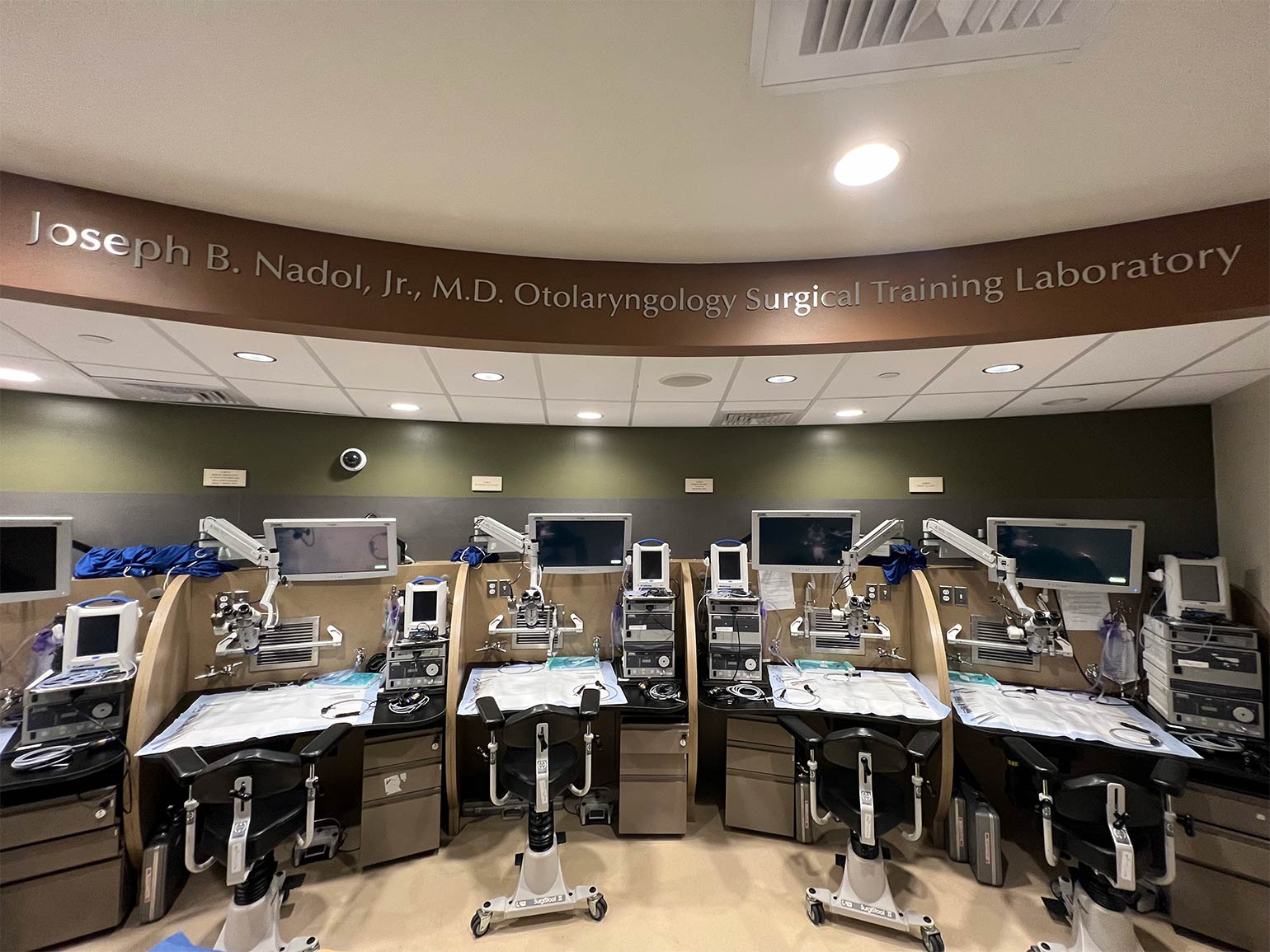
Figure 1
Hands-on lab session in the Joseph B. Nadol Jr., MD, Otolaryngology Surgical Training Laboratory at Mass Eye and Ear.
Q: What topics will the curriculum cover?
Dr. Rahmati: The curriculum covers the fundamentals of salivary gland disease, with a primary focus on salivary stones and ductal stenosis and their management through case-based presentations and panel discussion.
In addition, the course addresses practical aspects of care, including surgical outcomes, complications and their management, handling and care of sialendoscopes, and reimbursement considerations.
Management of complex stone and inflammatory disease is also discussed, including the role of robotic surgery and adjunctive therapies such as botulinum toxin chemodenervation.
The course concludes with a hands-on lab that provides participants with the opportunity to work closely with faculty. The lab focuses on a thorough understanding of the instruments used in sialendoscopy and the practical steps required to perform the procedure successfully in both office and operating room settings. Participants will learn a stepwise approach to sialendoscopy, with particular emphasis on ductal access, ductal dilation, stone retrieval, and troubleshooting when challenges arise.
Q: Are there any presentations you’re particularly excited about?
Dr. Rahmati: I am excited about all of the sessions, as each one addresses a fundamental aspect of managing salivary gland disorders with sialendoscopy at the center.
What excites me most is bringing together a group of experts in sialendoscopy and salivary gland disease and sharing that collective knowledge with a group of enthusiastic learners who will carry these lessons forward in caring for their patients and continue to grow the field.
This is a day of learning from multiple perspectives on both common and more complex presentations involving the salivary glands. It also naturally generates discussion and questions, often with more than one reasonable approach, which is where much of the value comes from.
In my experience, with an opportunity like this, it is rare to leave without seeing something differently or learning something new and unexpected, regardless of prior experience.
Q: What do you envision for the future of sialendoscopy?
Dr. Rahmati: Sialendoscopy has already changed how we manage salivary gland disease by allowing direct diagnosis of intraductal pathology and minimally invasive, gland-preserving treatment.
Looking ahead, the focus will be on continued refinement of these techniques and broader integration into clinical practice, particularly expanding the use of office-based sialendoscopy.
There are still many challenges in managing patients with salivary gland disorders, and sialendoscopy remains an important tool in our approach to care. Ongoing research and education will help refine how we use these treatments and move us toward more individualized management.
Find out more about the Mass Eye and Ear Sialendoscopy Course
Learn about Otolaryngology–Head and Neck Surgery at Mass Eye and Ear