Transforming Our Understanding of Ménière’s Disease
Key Findings
- New insights reveal that Ménière’s disease is driven by abnormal cell overgrowth in the inner ear, not simply by fluid pressure as long believed
- This harmful cell overgrowth appears to be the inner ear’s misguided attempt to repair itself after it initially sustained damage to the endolymphatic sac
- Different underlying problems damage the endolymphatic sac in different patients, and researchers have defined the first disease subtype using imaging and genetics—opening the door to more precise diagnosis and personalized, targeted therapies
This article was written by Nicole Feldman and republished from the Fall 2025 Harvard Otolaryngology Magazine.

Subscribe to the latest updates from Otolaryngology Advances in Motion
Before 1861, sudden spells of vertigo, ringing in the ears and fluctuating hearing loss were blamed exclusively on brain disorders. French physician Prosper Ménière overturned that view by showing that, in some patients, these symptoms arise from disease in the inner ear—home to the organs of hearing and, newly recognized at the time, balance. In his early autopsies of individuals with combined hearing and vertigo symptoms, Ménière described “swollen inner ear membranes,” later interpreted as a sign of excess inner ear fluid pressure, or endolymphatic hydrops. Ménière’s finding came to be regarded as the defining feature of the disorder that would bear his name.
Following Ménière’s early descriptions, the field largely adopted a “pressure-based model,” viewing the disease for decades as a local fluid problem and earning it the nickname “glaucoma of the inner ear.” The analogy seemed natural because in both conditions, elevated fluid pressure was thought to trigger attacks and cause long-term damage.
“Many diagnostic tests, both past and present, try to detect excess fluid, and first-line therapies—like low-salt diets and diuretics—aim to lower that alleged pressure,” said Andreas H. Eckhard, MD, Assistant Professor of Otolaryngology–Head and Neck Surgery at Harvard Medical School and Co-Director of the Otopathology Laboratory at Mass Eye and Ear. “Some surgical approaches even attempt to create an opening in the inner ear to let excess fluid out.”
Despite these efforts, no therapy stops disease progression, and even their benefits for acute symptom attacks remain inconsistent. “The pressure-centric model has not delivered effective, durable therapies for patients,” Dr. Eckhard noted. The unpredictability and relentlessness of symptoms is often devastating, affecting every aspect of a patient’s life, including mental well-being and day-to-day safety. For approximately 30 percent of patients who develop the disease in both ears, the impact is especially profound.
“It’s not just an ear disease,” Dr. Eckhard added. “It touches every part of life, from the ability to work, to socialize, to feeling safe. And because symptoms flare without warning, patients find themselves needing care and adjustment of therapy again and again. That’s why finding treatments that truly help with lasting effect is so urgent.”
Revisiting the foundations
With that in mind, Dr. Eckhard’s team returned to the original human tissue evidence to test whether the basic story of pressure-driven hydrops still holds up under modern scrutiny.
Mass Eye and Ear’s Otopathology Laboratory, a basic and translational human temporal bone pathology center, houses one of the world’s most extraordinary resources for this work: approximately 5,000 human temporal bones, including more than 100 from patients with Ménière’s disease. Prepared over decades for microscopic analysis into more than two million tissue sections and recently largely digitized at cell-level resolution, these precious specimens allow today’s researchers to re-examine long-standing ideas using cutting-edge, machine learning–supported approaches.
“More than half a century ago, researchers looked at these very same specimens with the best microscopes, guided by the prevailing mechanistic hypotheses,” Dr. Eckhard explained. “What they saw seemed to support the idea of increased fluid pressure. But microscope techniques weren’t as sophisticated then, and there was no artificial intelligence to enhance the analysis of these tissues at different levels and scales.”
Using advanced laser microscopy, 3D reconstruction techniques and machine-learning–assisted image analysis, the team reanalyzed classic sections alongside newly prepared material. The results challenged the traditional pressure theory. Instead of the thinned or stretched membranes expected if high pressure were the cause, hydropic regions consistently showed a striking increase in epithelial cell number: hyperplasia. These changes appeared in both early and advanced specimens, pointing to an active, cell-driven process. Molecular profiling reinforced that the expanded epithelial layers overexpress proteins involved in fluid and ion regulation, demonstrating a biological “rescue response” that adds cells and transport capacity to compensate for lost function, rather than simply ballooning under pressure. As in other organs, a protective response can become maladaptive if it overshoots or persists.
“Our new data suggest hydrops isn’t primarily a pressure problem,” said Dr. Eckhard. “It’s an organ-level rescue response that can tip from helpful to harmful when it runs unchecked.”
The roots of disease
This finding naturally led to the next question: if hydrops is the inner ear’s rescue response, what injury is it responding to?
The team focused on the endolymphatic sac, a small but crucial structure that keeps the inner ear’s fluid and chemistry in balance. Previous studies from Dr. Eckhard's group showed that the sac is injured in nearly all Ménière’s patients. In about 30 percent of cases, the sac and its bony channel—the vestibular aqueduct—never fully develop, leaving an underdeveloped sac from birth. In the remaining roughly 70 percent, a sac that formed normally later degenerates, likely from inflammation or reduced blood supply. In both cases, much of the sac’s epithelial lining—the cells that move salts and fluid—is lost, weakening the system’s “pump.” By combining earlier observations with new imaging and analysis, the team found that other inner-ear membranes grow extra cells, or undergo hyperplasia, to compensate for the sac’s lost function. This added tissue creates the swollen appearance recognized clinically as hydrops.
This new framework, detailed in the team’s recently published Scientific Reports work, knits the pathology data into a clear sequence: an upstream problem in the endolymphatic sac; a downstream hyperplastic “rescue” response by other inner-ear, fluid-facing membranes; and, when that compensation is partial or misdirected, a vicious cycle of injury and imperfect repair that continues to cause symptoms and over time, can damage or destroy the inner ear. Ongoing animal studies aim to separate the “good” aspects of this compensation, which stabilize the system, from the “bad,” which drive chronic disease, with the goal of enhancing the former and reducing the latter.
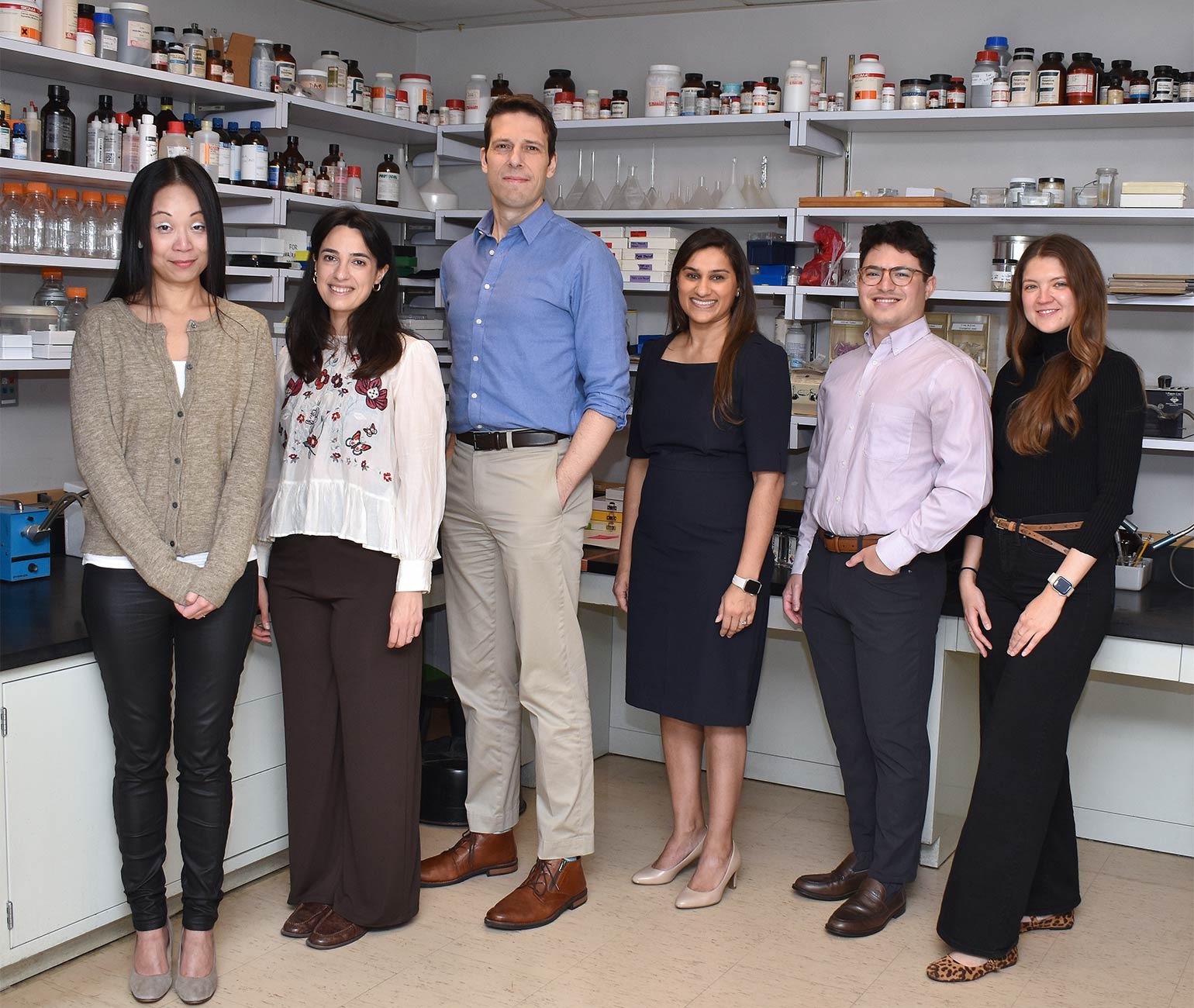
Figure 1
Members of the Eckhard lab from left to right: Amy Juliano, MD; Paula Robles Bolivar, PhD; Andreas H. Eckhard, MD; Divya A. Chari, MD; Corey Bryton; and Diana Correa, MD.
From tissue clues to patient care
Building on these tissue insights, the team asked whether the two sac patterns can be identified in living Ménière’s patients and whether they correspond to different causes, clinical profiles or therapy needs.
To bridge pathology and clinical application, the team—which included Divya A. Chari, MD, Lecturer of Otolaryngology–Head and Neck Surgery at Harvard Medical School and neurotologist and investigator at Mass Eye and Ear, and Amy Juliano, MD, Associate Professor of Radiology at Harvard Medical School and staff radiologist at Mass Eye and Ear—developed and clinically standardized a simple, reproducible CT/ MRI marker: the angular trajectory of the vestibular aqueduct (ATVA), which measures the bend of the bony channel that encases the endolymphatic duct and sac. On high-resolution CT, an angle of 140 degrees or greater indicates the underdeveloped, or hypoplastic, type, while an angle of 120 degrees or less points to a degenerative type. The ATVA marker, for the first time, enables grouping Ménière’s patients by underlying disease mechanism rather than symptoms alone—a diagnostic refinement known as endotyping.
In retrospective and prospective patient studies, the team showed that ATVA reliably distinguishes Ménière’s patients by sac pathology. It also helps anticipate the clinical course—for example, earlier onset and a higher likelihood of bilateral involvement in the underdeveloped type—and guides counseling and follow-up. In further work, ATVA patterns have correlated with later interventions such as cochlear implantation, improving long-term planning for patients with severe hearing loss.
Endotyping also opened the door to in-depth genetic analyses aimed at understanding why the disease develops in the first place. Using the ATVA marker to identify the underdeveloped type, the team found a strong link within this patient subgroup to X-linked hypophosphatemia (XLH), a rare condition caused by variants in the PHEX gene. In their medRxiv preprint, the association between the hypoplastic form of Ménière’s disease and XLH was far stronger than expected by chance. Detailed genetic analyses revealed a clear gene-dosage effect: males with fully inactivating PHEX variants were most likely to develop early, bilateral disease of the underdeveloped type; mosaic or milder variants showed attenuated involvement; and female carriers often experienced fluctuating hearing loss with variable expressivity. “This was the breakthrough we were looking for,” said Dr. Chari. “It explains why some patients develop severe, bilateral disease early and points to a concrete biological pathway we can target.”
What’s next
With a novel disease mechanism mapped out, an imaging tool for the clinic and a genetic foothold in a defined subgroup, the team’s next step is to connect these discoveries to improve personalized patient care.
Recognizing Ménière’s disease as a family of biologically distinct endotypes reframes diagnosis, monitoring and treatment. Building on their pathology– imaging–genetics framework, the Mass Eye and Ear team is mapping the molecular signals that drive protective epithelial growth versus maladaptive remodeling, aiming to strengthen the former and temper the latter. They are also translating these insights to the clinic by integrating the angular trajectory of the ATVA into routine imaging to guide counseling, follow-up, research enrollment, and link patterns with longitudinal hearing and balance outcomes. For patients with the hypoplastic endotype, the PHEX pathway provides a concrete target for therapeutic and preventive interventions.
“We’re not just rethinking the disease; we’re redefining it from its cellular roots to patient care. Ménière’s is no longer a single mysterious disorder but a set of biologically distinct conditions, each with its own path to prevention or treatment,” said Dr. Eckhard.
As efforts progress, the team’s recent review in Frontiers in Neurology presents a practical framework— endotype-based diagnosis, imaging-guided monitoring and pathway-targeted research—to guide care today while accelerating studies needed for lasting treatments and, potentially, cures. They envision endotypespecific pathways and trials that align interventions with each patient’s biology, shifting from reactive symptom control to proactive, mechanism-guided prevention and treatment to preserve hearing and balance over the long term.
Learn about the Department of Otolaryngology–Head and Neck Surgery